On April 24, 2026, Hanoi Pedagogical University 2 (HPU2) hosted a working session with a delegation from Harbin Institute of Technology (China). The visit opened up promising prospects for strategic cooperation in education and high-tech scientific research.
.jpg)
Delegates attending the Working Session
Participants and Working Atmosphere:
The delegation from Harbin Institute of Technology included: Prof. Zhang Qinwu – Vice President; Prof. Sun Tao – Dean, Modern Digital Governance School of Government; Assoc. Prof. Peng Ke – Deputy Dean, School of Economics and Management, Faculty of Future Studies; Assoc. Prof. Yang Lei – School of Ecological and Environmental Engineering, Faculty of Artificial Intelligence; Ms. Li Dan – Deputy Dean, Office of International Office, along with other delegation members.
Welcoming and working with the delegation, on the side of Hanoi Pedagogical University 2 were: Dr. Bui Kien Cuong – Deputy Secretary of the Party Committee, Vice Rector of the University; Heads of the Science, Technology & International Cooperation; Deputy Head of the Political and Student Affairs Office; Academic Affairs Office; Faculty of Chinese Language; Faculty of Biology; Faculty of Chemistry, and the Institute of Information Technology.
.jpg)
Dr. Bui Kien Cuong – Deputy Secretary of the Party Committee and Vice Rector of the University delivered welcome remarks
The working session took place in an open, sincere, and friendly atmosphere. Following the welcome remarks, representatives from both sides watched introductory video materials highlighting their history, educational strengths, and potential areas of cooperation. Leaders of both institutions affirmed that this visit marks an important milestone, laying a solid foundation for a long-term partnership.
Promoting multidisciplinary training and research cooperation
.jpg)
Prof. Zhang Qinwu – Vice President of Harbin Institute of Technology delivered remarks at the working session
During the meeting, delegates participated in a discussion on content related to cooperation between the two sides, co-chaired by Dr. Bui Kien Cuong and Prof. Zhang Qinwu. Both sides exchanged information regarding their respective training capabilities and scientific research capacities which took place in an open atmosphere.
.jpg)
Delegates Exchange Views at the Working Session
Content of common interest to both sides includes:
First, Student and Academic Exchange: Developing joint training programs, with a particular focus on the application of Artificial Intelligence (AI) in management and teaching.
Second, Scientific Research Cooperation: Co-hosting international conferences and collaborating on research projects in Robotics, Nanotechnology, Biotechnology, and Environment.
Third, promote the image: Establish dedicated introduction sections about each partner institution on their respective official websites to enhance brand recognition.
Fourth, Exchange management practices: Facilitate visits for faculty and staff to exchange experiences in modern university administration and the application of technology in curriculum development.
Following discussions, both sides agreed to assign representatives to sign a Memorandum of Understanding (MOU) in the spirit of solidarity and cooperation, aiming to provide high-quality human resources to serve the economic and cultural development of both countries.
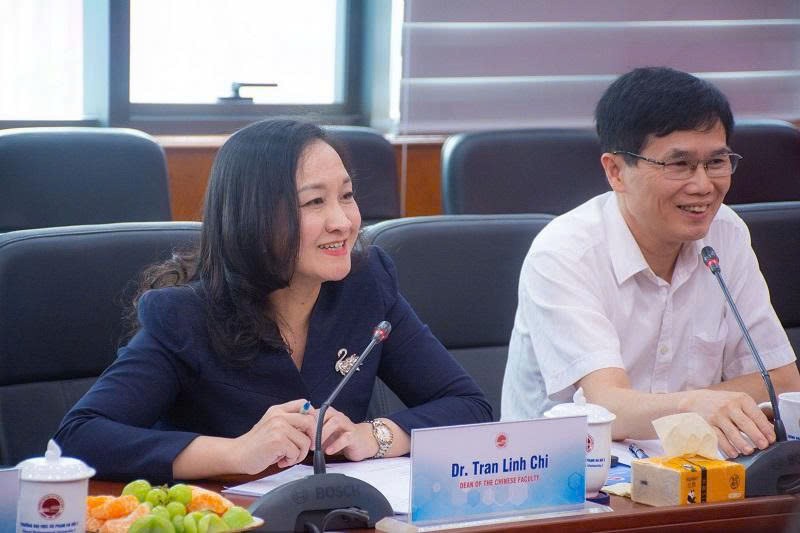
Dr. Tran Linh Chi – Dean of the Faculty of Chinese Language, Hanoi Pedagogical University 2, spoke at the working session
Breakthrough Opportunities for Faculty and Students
The collaboration between the two sides is not limited to written agreements, but opens up breakthrough opportunities for both academic staff and students. This serves as a "gateway" for Hanoi Pedagogical University 2 students to access an international learning environment in Shenzhen— where technologies converge, such as AI, Robotics, and Nanotechnology—to cultivate practical skills and creative thinking. At the same time, this academic integration creates an ideal environment for faculty members to join research teams, co-lead international-caliber scientific projects, and share modern university governance experiences, thereby unlocking potential and realizing the goal of training high-quality human resources for both nations.
.jpg)
Delegates took a photo at the working session
Harbin Institute of Technology
Established in 1920, it is a key national university directly under the Ministry of Industry and Information Technology of China. Notably, its Shenzhen campus plays a pioneering role, located in "China's Silicon Valley," which is one of the world's leading fast-growing metropolises.
Currently, the university trains nearly 14,000 students (with international students accounting for 15%) from Bachelor's to Doctoral levels. It is renowned for its outstanding programs in Information Technology and space research, while maintaining an extensive network of partnerships with research organizations across more than 30 countries and regions.
.jpg)
https://hpu2.edu.vn/vi-VN/hpu2-bai-viet/khcn-va-htqt/chuong-trinh-trao-doi-sinh-vien-tai-dai-hoc-buu-chinh-vien-thong-trung-khanh-ky-mua-thu-2025
06/03/2025



.jpg)